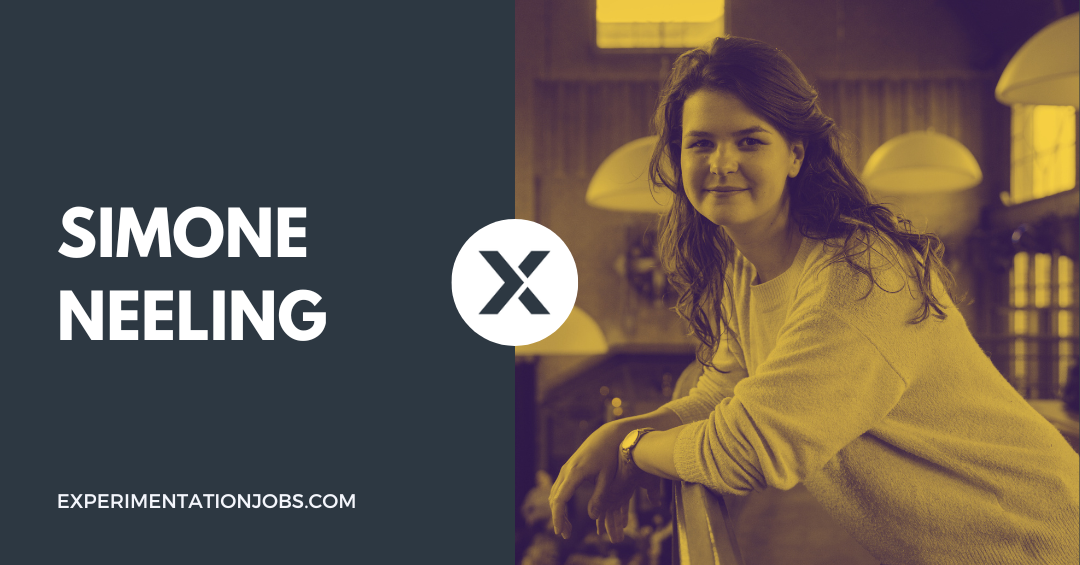
The goal of this interview series is to inspire and help people to transition their career into a new or next experimentation related role. In this edition, Simone Neeling shares her journey. She is a Senior Experimentation Specialist at VodafoneZiggo.
In a large corporate organization, it’s often more important to focus on reducing risk than waiting until you’re 100% sure something will work.
Simone Neeling
Please introduce yourself to the readers
Hi! Simone here. I live in Utrecht in The Netherlands together with my husband and our son. I’m a coffee enthusiast and love cooking vegan food. Besides CRO, I also work as a wedding and newborn photographer on the side as a creative outlet.
What is your current experimentation role and what do you do?
I currently work as a Senior Experimentation Specialist at VodafoneZiggo. I’m part of a multidisciplinary team that focuses on acquisition sales for the Ziggo brand across all channels. My main focus is improving the webshop through qualitative and quantitative insights. Beyond that, I spend time promoting an experimentation culture within the company, helping colleagues to work more data-driven and test ideas and new initiatives.
How did you enter the experimentation space? What was your first experimentation related role?
I started my career at VodafoneZiggo as a trainee and later moved into an e-commerce product owner role. That was also around the time that VodafoneZiggo started working more seriously with experimentation. I quickly became fascinated by A/B-test results, specifically by the psychological constructs that explained them. It made me curious. So when an experimentation role opened up, I couldn’t resist diving in so that I could spend more time on this. I didn’t have a strong analytics background at the time, so I had a lot to learn. You could even say that applying for the role was an experiment in itself, because I knew so little about what the actual day to day work would look like. It paid off, because I’ve never left the experimentation space since.
How did you start to learn experimentation?
By doing, making mistakes and learning from them. After taking a few courses on experimentation and web analytics, I started setting up my first tests with support from more experienced colleagues. At VodafoneZiggo we encourage trial and error, and having a safe environment to make mistakes helped me pick up new skills quickly. A big factor for me was our famous ‘Fail Party’, where everyone shares their failures and we vote for the ‘Fail of the Year’. Seeing very experienced people make what seem like ‘stupid’ mistakes made it much easier for me to ask for help when I got something wrong myself.
How do you apply experimentation in your personal life? (what are you tinkering with or always optimizing?)
I became a mother a few months ago, so at the moment I’m mostly optimizing… sleep! Both my own and my son’s, as there seems to be a pretty strong causal relationship between the two 🙂 Besides trying different pajamas, sleeping bags and all kinds of other things, I’ve even tried experimenting with an app that uses prediction models to optimize a baby’s sleep schedule. It turns out, though, that my son does not really care what the data says, haha.
What recommendations would you give to someone who is looking to join the experimentation industry and get their first full-time position?
Key factors for me were a safe environment to make mistakes and learn, and to have more experienced specialists around me who were willing to share their knowledge. I’d encourage people to be hands-on in such an environment as early as possible, while also building some foundational knowledge through courses. You don’t need to know everything before you start. I believe that willingness to learn, curiosity and having the right mindset are just as important when you start.
Which developments in experimentation excite you? How do you see the field changing in the next 5 to 10 years?
I’m excited about how AI has already allowed me to work more efficiently. I mainly use it to code my own experiments, which makes me less dependent on front-end development, and allows me to run more tests. It feels like we’re only at the beginning, and in the future I hope AI can help me with other tasks so that I can spend more time on building our internal experimentation culture. Looking back, we’ve made a lot of progress in that area over the past few years, but in a large company, influencing the way of working can still be a slow process. I think that’s why some things will not change anytime soon: experimentation specialists will always need empathy, curiosity, strategic thinking and the ability to inspire others. I hope that experimentation becomes more and more at the front and center in product development, as a full mindset and not just a tool.
What is the experimentation book that has influenced your thinking the most? What is one idea from it that you still use today?
I’m naturally someone who likes to be certain before making important decisions. But one of the biggest lessons I have learned in my role as an Experimentation Specialist, is that in a large corporate organization, it’s often more important to focus on reducing risk than waiting until you’re 100% sure something will work. It’s not a lesson from a specific book I read, but it’s a guideline I remind myself of every day and it has really changed how I approach experimentation.
Is there anything people reading this can help you with? Or any parting words?
I’d love to help further democratize experimentation at VodafoneZiggo, so it becomes an even more integral part of everything we do. I’m curious to hear how others make experimentation part of their company culture, specifically regarding things like running internal experimentation academies or teaching colleagues from other disciplines how to set-up and analyze experiments. If that’s you, I’d love to connect and exchange ideas.
Which other experimenters would you love to read an interview by?
Annemarie Klaassen, Daphne Tideman, Luiza de Lange, Marit Groot Zevert, André Morys
Thank you Simone for sharing your journey and insights.