
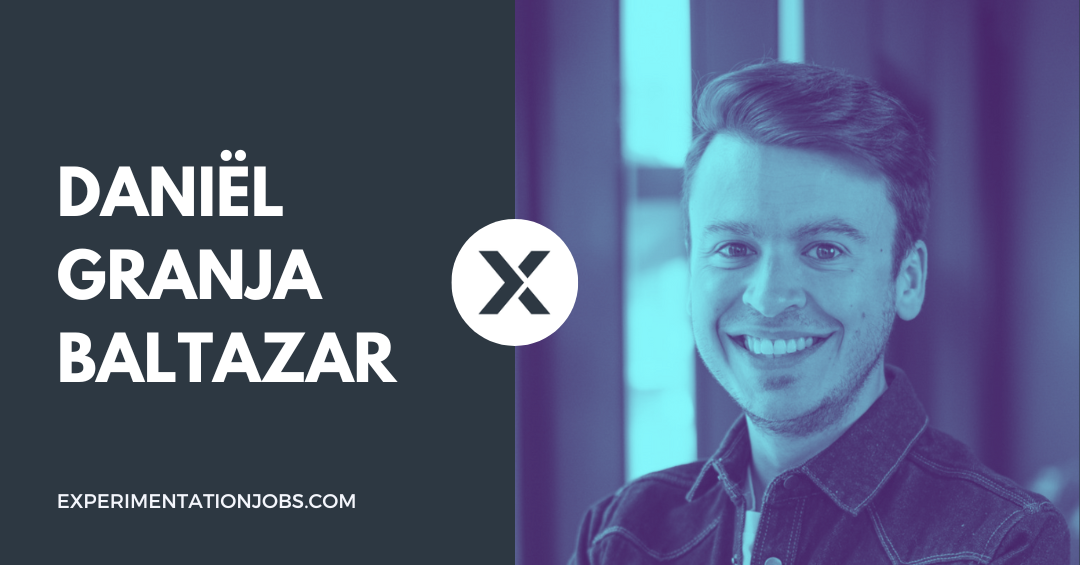
The goal of this interview series is to inspire and help people to transition their career into a new or next experimentation related role. In this edition, Daniël Granja Baltazar shares his journey. He is a Conversion (CRO) Specialist B2B at VodafoneZiggo.

Working at a digital agency teaches you time management skills and how to say no. On top of that, it will strengthen your professional network in a short amount of time. And the parties are fun too.
Daniël Granja Baltazar
Please introduce yourself to the readers
Hi! I am Daniël Granja Baltazar. Born and raised in the city of Rotterdam (in the Netherlands) to Portuguese parents. As a result, I was raised bilingual. From an early age I was interested in communication, psychology (Why do people do what they do?), technology and cultural differences.
During my International Business & Languages bachelor’s degree at Hogeschool Rotterdam I lived abroad twice: 6 months in Paris (for a sales and marketing internship) and 6 months in São Paulo (for a study exchange). Later I completed a master’s degree in Marketing Management at Tilburg University.
I love to spend time with family and friends, traveling to foreign countries with my girlfriend (Jordan is next on the list), drawing, running, playing tennis, and building personalized wrist watches. The latter is a side hustle that I have been doing for the past 3 years.
What is your current experimentation role and what do you do?
Since November 2022, I have been working as a Conversion (CRO) Specialist B2B at VodafoneZiggo. I am responsible for improving the customer experience of the Vodafone Business website and the Vodafone Business Marketplace. The latter is the platform where we sell software applications to business customers. This platform has two user groups: companies and resellers.
In my daily work I combine both quantitative research (e.g., web analytics, heat maps, AB testing, event tracking) and qualitative research (e.g., surveys, user interviews, usability testing, session recordings) to achieve long-term business growth. A project that I am especially proud of is the redesign of the Vodafone Business homepage. This project combined various research methods (workshop between different departments, pre-validation in Lyssna, user interviews, AB testing) to deliver a new homepage that improves the experience on the Vodafone Business website. It was awarded an Experimentation Elite Award in June 2025 in the B2B category (other finalists were Booking and Macpaw).
The homepage redesign is an exemplary project of what gives me the most energy: building bridges between different departments (CRO, UX, marketing, sales, customer service) to achieve long-term business growth.
How did you enter the experimentation space? What was your first experimentation related role?
Funny enough my story did not start in marketing or experimentation. It started in sales, recruitment to be more precise. After I graduated in the summer of 2015 I was approached by a recruitment agency who were looking for recruitment consultants for their office in Rotterdam. I hear you thinking: “Sales? Recruitment?” You are probably thinking about The Wolf of Wall Street or a similar sales stereotype, right?
What I found out during my first two weeks of training was that sales is actually the opposite of that. It is about asking open questions, listening, summarizing what was said, and asking the right follow-up questions. All with one clear goal in mind: finding out what the problem of the potential customer is. Once you know that, you are able to determine whether or not you are able to help him/her.
After working at the recruitment agency for 4 months I was asked whether I would like to help to set up a new label within the same recruitment group. This meant starting from zero in a totally new market. My answer was without hesitation: “Yes of course!” Setting up this new recruitment label meant that my colleagues and I had to find everything out ourselves. This meant testing out a lot of different things. Some things worked, some things did not. Every week we would sit together to share what we had learned the week before. I did not know it at the time, but this is basically the essence of experimentation (validated learning).
How did you start to learn experimentation?
After having worked in recruitment for little more than 1 year, I decided to move back into digital marketing. Because I did not know which industry I would prefer, I decided to apply at a digital agency. The founders of Zicht online, a small 30-man agency in Rotterdam, gave me a shot. And that basically changed the trajectory of my career.
Working as a marketing consultant at Zicht online, I learned about SEO, SEA, email marketing, marketing automation and CRO.
My first AB test was set up in Google Optimize. I ran an AB test for a Dutch museum in early 2017. They had an ongoing debate, which had been going on for years, between the marketing department and the museum curators. The marketers wanted to promote upcoming exhibitions with short pages with one trailer video, that enticed users to buy a ticket (much in a way like cinemas do). The museum curators were of the argument that art enthusiasts want to know as much as possible about the exhibition before deciding to purchase a ticket.
The solution that I proposed? Setting up an AB test in Google Optimize. The control was the long exhibition page (as they were currently being created by the museum curators). The variant was a short exhibition page that put the trailer video front and center. After 4 weeks it was time to analyze the results:
- Time on page: -50% on the variant
- Tickets sold: +700% on the variant
The museum employees were over the moon with the results. And something special happened after this test: the marketing department and the museum curators started to think together about what to test next.
This first case study set up my appetite for experimentation and data-driven marketing. After having worked for 2 years at Zicht online, I spent 4 years working at two other digital agencies (Ice Cream Media, DEPT). This gave me the opportunity to experience a lot of different industries (e.g. e-commerce, retail, real estate, financial services, meal delivery, education, SaaS) and a lot of different markets (e.g. Benelux, DACH, France, Spain, UK, Scandinavia, North America) from the inside.
How do you apply experimentation in your personal life? (what are you tinkering with or always optimizing?)
I think working in CRO has strengthened this curious learning mindset that I have had in me since I was young. With everything that I do I try to check whether the assumptions that I have are correct and I try to optimize my way of working.
To give one example: when I started out with my watch business Uniq Watch Mods I had a clear target audience in mind. I thought most of my customers would be men from the Benelux region, aged between 25 and 45 years old, who already own multiple mechanical watches.
The reality? I sell 90% of my watches outside of the Benelux region. Going as far as California and New Zealand. My customers are both men and women, aged between 18 and 60 years old.
By talking to every single customer, I found out that roughly 20% had never owned a mechanical watch before. That insight made me rewrite my product pages and the emails that I was sending to new customers.
What are you currently doing to keep up with the ever-changing industry?
Firstly, I am an active LinkedIn user. I post and engage on LinkedIn every week. This gives me a lot of insights of what is happening in other organizations and what kind of challenges other CRO experts are experiencing.
Secondly, I go to conferences. I do this both as a speaker and as an attendee. Talking to people at conferences face-to-face with a coffee or a beer, gives you a really good pulse check of what is currently happening.
Thirdly, I do online courses and training. In the summer of 2025 I attended the first AI Fluency Cohort (organized by Bjarn Brunenberg and Slobodan Manic). This 2-week hands-on course taught me how to build an AI workflow in n8n. What was really great about it was that during the 4 online calls you also learn from the other people attending the training. What worked? What did not? How did they solve a particular problem?
Lastly, in January 2026 I joined the Experimentation & Optimization Committee of DDMA (Data Driven Marketing Association) in the Netherlands. This allows me to see what different Dutch organizations are struggling with in terms of experimentation and data maturity. With my passion for mixed research methods (quantitative and qualitative), I am sure that I can help these companies achieve long-term business growth.
What recommendations would you give to someone who is looking to join the experimentation industry and get their first full-time position?
Go work at a digital agency! No, really, I am not joking. Working at a digital agency you get the chance to work for several clients who are active in different industries and in different markets. This means that a) you will learn a ton in a short period of time and b) you will find out which industry you like the most (which helps you to decide what to do next).
In addition, working at a digital agency teaches you time management skills and how to say no (trust me, some clients will keep pushing until they hear you say no). On top of that, it will strengthen your professional network in a short amount of time. And the parties are fun too.
Which developments in experimentation excite you? How do you see the field changing in the next 5 to 10 years?
AI is something that really excites me for a couple of reasons:
1. Data democratization: it becomes easier for people to have access to data and to analyze it.
2. Lowering the barrier to entry: as more tools (e.g. Contentsquare, Mopinion) are integrating AI, it becomes easier for users to digest that data into insights. These insights can then be turned into concrete next steps.
3. Freeing up time for the things that matter: as we have more time freed up by AI, we can spend less time on the boring stuff and more time on the complex stuff that matters.
In addition, I see that an increasing number of companies are starting to understand that experimentation is about understanding your (potential) customers and delivering them the best experience possible and not about applying some ‘quick hacks’ on your website.
What will not change in experimentation is the essence: it is about change management. You will encounter resistance along the way from people who aren’t convinced that things should be done differently. My advice would be to talk to these people, try to understand their point of view. And then start small. A small project that is showing positive first results, can turn experimentation skeptics into experimentation ambassadors.
Is there anything people reading this can help you with? Or any parting words?
There is no ‘I’ in the word ‘TEAM’. I know it sounds cliché, but allow me to explain.
The biggest business achievements are never achieved by one single person. Never! If you want to help your company achieve long-term business growth, it is essential that you team up with different departments.
This will require time, because relationships aren’t built in one day. But you will see that once you start to understand the point of views of different departments, once you start to understand their reality, that is when experimentation can become an enabler.
My recommendation to everyone working in experimentation is to spend one full day talking to people working in different departments: UX, marketing, sales, customer service. Ask them what their day looks like and what their biggest priority is for the upcoming quarter. It is by putting these pieces of the puzzle together, that you will be able to spot experimentation opportunities.
Which other experimenters would you love to read an interview by?
Bjarn Brunenberg
Timo Stegeman
Annemarie Klaassen
Thank you Daniël for sharing your journey and insights.

