

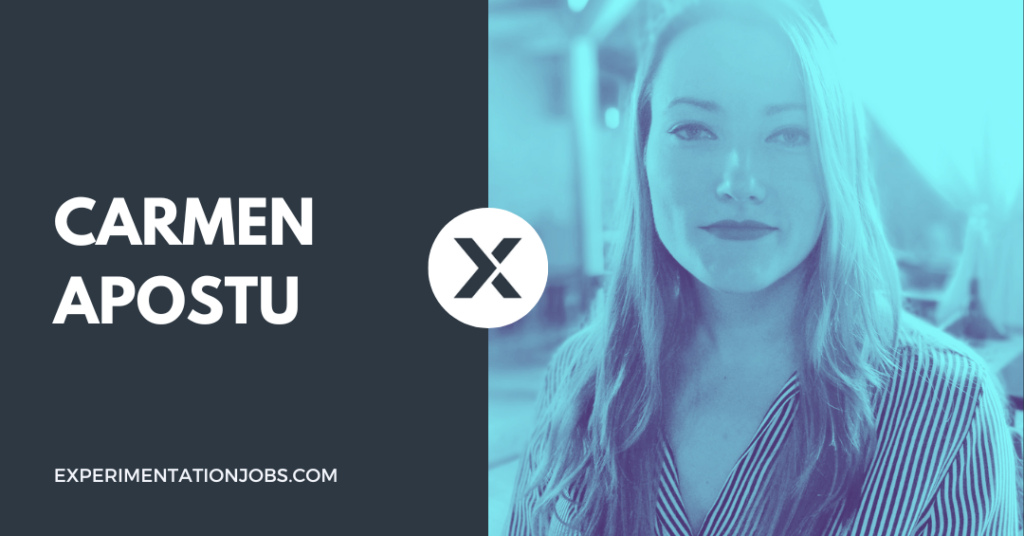
The goal of this interview series is to inspire and help people to transition their career into a new or next experimentation related role. In this edition, Carmen Apostu shares her journey. She is the Head of Growth Marketing at Convert.com.
One idea I keep coming back to is the framing of experimentation as a form of mindful productivity, where you replace big, scary goals with low-stakes experiments that lower pressure and make learning feel like a form of self-care.
Carmen Apostu
Please introduce yourself to the readers
Hey 👋 I’m Carmen – Transylvanian-born, spent a good chunk of my life in Colombia, Belgium, France, and a rotating cast of other places thanks to remote work. Work-wise, I’ve been in marketing for more than a decade, mostly trying to make it a little more thoughtful and a lot less extractive. To offset my screen time, I keep an enthusiastic, if imperfect, meditation & yoga practice going. Lately, I’ve been pouring a lot of energy into mentoring, working with refugees who want to break into remote work and with early-career marketers finding their footing.
What is your current experimentation role and what do you do?
I wear a few hats to drive Convert.com’s growth & content engine, which mostly means I sit at the intersection of performance and brand. I run experiments on paid acquisition, but I also spend a lot of time building and curating content for people who think deeply about experimentation.
How did you enter the experimentation space? What was your first experimentation related role?
My origin story is pretty unglamorous. I got promoted to marketing manager a couple of months into a role back in 2014. Suddenly, I was the person who had to answer for whether marketing was wOrKiNg. So I did what anyone does when they’re underwater. I panicked and cried in the office bathroom. And then I turned to Google & data for answers. Someone recommended this $19-a-month A/B testing tool and we started running little USP experiments, which made me way less easy to argue with :). You could say I stumbled into experimentation out of self-preservation. It stuck.
How did you start to learn experimentation?
Started by reading whatever the testing tool’s help center had and every CRO-related blog post I could find, like this oldie but goldie. Got the basics from Colin McFarland’s Experiment! and Siroker and Koomen’s A/B Testing. I also got lucky and worked with an experimentation-curious dev team.
How do you apply experimentation in your personal life? (what are you tinkering with or always optimizing?)
The experimentation I do outside of work probably outpaces anything I do professionally. I’m always testing small changes in my life. Sleep, food, fasting protocols, meditation practices, how much I’m on my phone.
What are you currently doing to keep up with the ever-changing industry?
Some of it is baked into my job. Working on the Convert blog means I’m reading an unreasonable amount of experimentation content every week. And the rest is the infrastructure I built over time: the right LinkedIn follows, Slack communities (Women in Experimentation, TLC), newsletters, and peers I trust to surface the stuff worth paying attention to. In-person events!
What recommendations would you give to someone who is looking to join the experimentation industry and get their first full-time position?
After interviewing nearly a hundred experimenters for the Think Like a Tester series, the thing that stands out is how few of them started in experimentation. Lots of folks wandered in sideways, from marketing, analytics, product, even poker, and figured it out as they went. So get adjacent. Join online communities, read the newsletters, build your network. And don’t wait for a job title to start testing things.
Which developments in experimentation excite you? How do you see the field changing in the next 5 to 10 years?
I’m excited and a little unnerved by how much AI is going to change experimentation. Some of it is about where decisions are moving, like shopping and product discovery happening inside AI interfaces, and some of it is about how easily we can spin up and run experiments at speed. Both are going to make this field look pretty different a decade from now. What won’t change is people’s appetite for learning.
What is the experimentation book that has influenced your thinking the most? What is one idea from it that you still use today?
Anne-Laure Le Cunff’s Tiny Experiments. Her newsletter is phenomenal too. One idea I keep coming back to is her framing of experimentation as a form of mindful productivity, where you replace big, scary goals with low-stakes experiments that lower pressure and make learning feel like a form of self-care.
Is there anything people reading this can help you with? Or any parting words?
Don’t be a stranger—we’re in the trenches together.
Which other experimenters would you love to read an interview by?
Marcella Sullivan. Ryan Levander. Iqbal Ali. Katie Faulkner & Yi-Hsuan Lin, the winners of our Speak Up To Uplevel competition last year!
Thank you Carmen for sharing your journey and insights.

